
What People Are Searching For vs What Actually Matters
If you’ve spent any time in the essential oil space, you’ve likely come across charts claiming certain oils vibrate at specific “frequencies” measured in MHz.
It’s a compelling idea.
Higher frequency = higher vibration = better outcomes.
Simple. Neat. Very shareable.
Also… not how chemistry works.
⚠️ The Reality Behind “Frequency” Claims
The commonly shared MHz values:
- are not scientifically validated measurements
- come from unverified claims dating back to the 1990s
- are widely considered pseudoscience in scientific communities
From a chemistry perspective:
- Essential oils are made up of multiple compounds
- Each compound has different vibrational behaviours
- There is no single measurable frequency for an oil
So while the charts look authoritative, they are not based on reproducible scientific data.
📊 The Commonly Circulated List
(What People Are Looking For)
Let’s acknowledge it anyway, because this is what people are searching for.
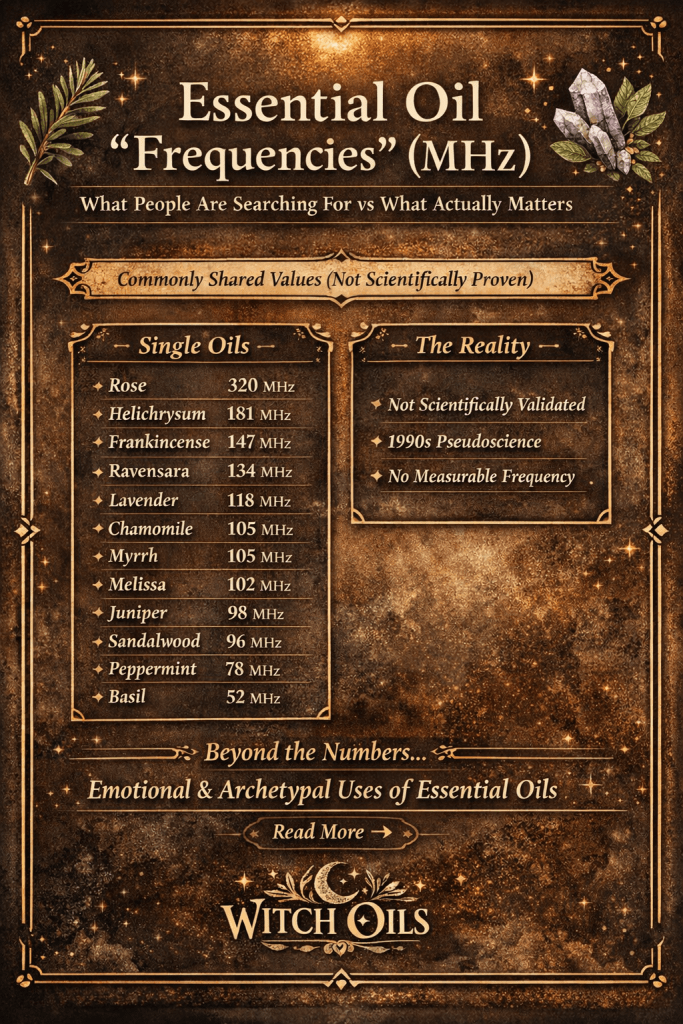
🌿 Single Oils
- Rose — 320 MHz
- Helichrysum — 181 MHz
- Frankincense — 147 MHz
- Ravensara — 134 MHz
- Lavender — 118 MHz
- Chamomile — 105 MHz
- Myrrh — 105 MHz
- Melissa — 102 MHz
- Juniper — 98 MHz
- Sandalwood — 96 MHz
- Peppermint — 78 MHz
- Basil — 52 MHz
🧾 What to take from this
- These values are commonly circulated, not measured
- They function more like modern folklore within aromatherapy
- Useful symbolically, not scientifically
🧠 Where It Goes Off Track
The biggest issue isn’t the single oil list. That stays relatively consistent.
The problem is the blends.
- Charts often mix different brands together
- Names are swapped, rebranded, or misattributed
- Values are inconsistent across sources
Once you strip out cross-brand contamination, the dataset becomes:
→ very thin, very fast
At that point, you’re left with a choice:
- keep chasing numbers that don’t hold up
- or work with something that actually does
🌿 A More Useful Approach: Emotional & Archetypal Pairing
This is where essential oils actually shine.
Read my blog post on how oils support:
- the nervous system
- emotional states
- ritual and intention
🧾 Final Word
The MHz charts aren’t going anywhere. They’re easy to share and easy to believe.
But they’re not what makes essential oils effective.
What matters is:
- composition
- quality
- how they interact with your body and mind
- and how you choose to work with them
If you’re building a practice around oils, build it on something that actually holds. I’ve worked with dōTERRA oils for many years, and now use a range of suppliers depending on quality, availability, and purpose.
Not just something that looks good in a graphic.
 Witch Oils
One response to “Essential Oil “Frequencies” (MHz)”
[…] of assigning a single number to a complex plant extract (see my blog post on Essential Oil “Frequencies” (MHz)), we look at how an oil feels, how it affects the nervous system, and how it has been used […]
LikeLike